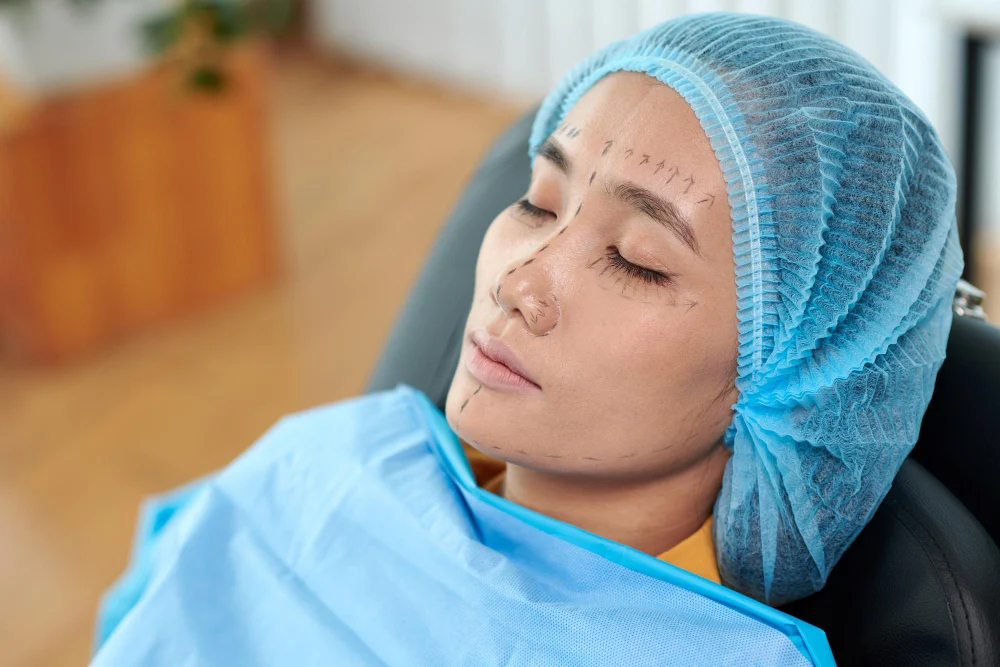
Summary:- Choosing the right anesthesia is an important part of deep plane facelift surgery. This blog compares general anesthesia and local anesthesia with sedation, explaining their benefits, limitations, patient experience, and safety considerations. It also shares why the surgeon prefers general anesthesia to achieve greater precision, patient comfort, and optimal surgical outcomes. When patients begin …


Summary:– Choosing the right anesthesia is an important part of deep plane facelift surgery. This blog compares general anesthesia and local anesthesia with sedation, explaining their benefits, limitations, patient experience, and safety considerations. It also shares why the surgeon prefers general anesthesia to achieve greater precision, patient comfort, and optimal surgical outcomes.
When patients begin researching a deep plane facelift, they usually focus on the surgical technique, recovery or before-and-after results. However, one equally important question is often overlooked:
Should a deep plane facelift be performed under general anesthesia or local anesthesia with sedation?
The answer is not simply a matter of personal preference. The choice of deep plane facelift anesthesia influences not only the patient’s comfort but also the surgeon’s working conditions and, ultimately, the precision with which this highly specialised operation can be performed. To set a realistic baseline for your recovery and final outcomes, establishing a clear deep plane facelift expectation early on is essential.
Both deep plane facelift general anesthesia and deep plane facelift local anesthesia are used by experienced surgeons around the world. Every surgeon develops their own philosophy based on training, experience and the type of surgery they perform. If you are seeking an expert deep plane facelift surgery in London, finding a specialist who aligns with these strict procedural philosophies is key.
In my own practice, every deep plane facelift and deep neck lift is performed under general anesthesia. This is not because local anesthesia cannot be used. Rather, I believe general anesthesia provides the safest, most controlled and most predictable environment for this technically demanding procedure.
Key Takeaways
- Deep plane facelift anesthesia can be provided under either general anesthesia or local anesthesia with intravenous sedation.
- Both techniques have advantages and should be selected according to the procedure, the patient and the surgeon’s experience.
- In my practice, every deep plane facelift is performed under general anesthesia.
- General anesthesia allows the patient to remain completely still while providing optimal operating conditions for meticulous facial surgery.
- Local anesthesia with sedation requires careful balancing of patient comfort while maintaining spontaneous breathing.
- I believe that a secured airway, complete patient comfort and absolute stillness provide the ideal environment for complex facial rejuvenation surgery.
Why Does Anesthesia Matter During a Deep Plane Facelift?
A deep plane facelift is fundamentally different from a traditional skin-only facelift.
Rather than simply tightening loose skin, the operation involves releasing the retaining ligaments, working beneath the SMAS layer and repositioning the deeper facial tissues. The procedure is performed close to delicate facial nerves, important blood vessels and other vital anatomical structures.
This is precision surgery.
Small details make a difference.
The operating conditions therefore become extremely important. Good visibility, meticulous haemostasis, complete concentration and patient cooperation all contribute to achieving the best possible result.
When considering the intricate anatomy involved, many patients understandably ask: is a deep plane facelift safe? The short answer is yes, but safety relies heavily on a controlled environment and a highly trained surgical team. For this reason, the type of anesthesia is not simply about making the patient comfortable. It also creates the environment in which the surgery is performed.
What Is General Anesthesia?
During deep plane facelift general anesthesia, the patient is completely asleep and unaware of the operation.
A consultant anesthetist remains present throughout the entire procedure and continuously monitors:
- Heart rate
- Blood pressure
- Oxygen saturation
- Breathing
- Cardiac function
- Overall patient stability
The airway is secured from the beginning of the operation, allowing breathing to be fully controlled throughout surgery.
From the patient’s perspective, the experience is remarkably straightforward. Most patients describe falling asleep in the operating theatre and waking up comfortably in the recovery room. The operation itself often feels as though only a few moments have passed.
Modern general anesthesia has an excellent safety profile when delivered by an experienced consultant anesthetist following an appropriate medical assessment.
Can a Deep Plane Facelift Be Performed Under Local Anesthesia?
Yes.
Some experienced surgeons perform a deep plane facelift under local anesthesia, usually combined with intravenous sedation.
In this setting, local anesthetic is injected into the facial tissues while sedative medication helps the patient relax or sleep lightly throughout the procedure.
For selected patients, this can be an appropriate technique.
However, it also creates a very different operating environment.
Unlike general anesthesia, the patient is not fully unconscious. Depending on the depth of sedation, patients may drift in and out of sleep during surgery. Some remember very little afterwards, while others remember conversations, movement, pressure, sounds or periods of wakefulness. Interestingly, this approach is often requested during a deep plane facelift for men, where patients sometimes look for office-based or lighter sedation options, though the structural complexity of male facial anatomy remains just as demanding.
The level of sedation is continuously adjusted throughout the operation by the anesthetist according to the patient’s comfort and breathing.
General Anesthesia vs Local Anesthesia
| General Anesthesia | Local Anesthesia with Sedation |
| Patient completely asleep | Patient awake or lightly sedated |
| Airway secured throughout surgery | Patient breathes spontaneously |
| Complete patient stillness | Some movement may occur |
| Maximum patient comfort | Suitable for selected patients |
| Excellent operating conditions for lengthy surgery | Requires continuous adjustment of sedation |
Both approaches can be used successfully.
The choice ultimately depends on the surgeon’s experience, the patient’s medical history and the complexity of the planned operation.
Why I Choose General Anesthesia
Every surgeon develops their own philosophy.
My decision to perform every deep plane facelift under general anesthesia is based primarily on one principle:
Precision.
A deep plane facelift often takes several hours to perform.
Throughout the procedure, I work close to delicate facial nerves while releasing retaining ligaments and repositioning the deeper facial tissues. Every movement is deliberate and requires absolute concentration.
I want my patient to remain completely still throughout the operation.
Under local anesthesia with sedation, this is much more difficult to achieve.
Even when sedation is working well, patients may move slightly because they become uncomfortable lying in one position for several hours. They may reposition their head, react to pressure, speak, ask questions or become restless before drifting back to sleep again.
These interruptions are entirely understandable from the patient’s perspective.
From the surgeon’s perspective, however, they interrupt delicate moments of dissection where complete concentration and absolute stillness are highly desirable.
Another important consideration is the sedation itself.
During deep plane facelift local anesthesia, the anesthetist must continuously balance two competing objectives.
The patient must receive enough sedative medication to remain comfortable, while at the same time continuing to breathe independently.
As sedation becomes deeper, these medications can suppress the patient’s breathing.
In the worst-case scenario, breathing may become inadequate or stop altogether, requiring immediate airway management, including emergency intubation.
Experienced anesthetists are highly trained to recognise and manage these situations, but it illustrates the constant balancing act required throughout prolonged deep sedation.
With general anesthesia, this balance no longer exists.
The airway is secured from the very beginning of the operation. Breathing is fully controlled, the patient remains completely motionless and I can devote my complete attention to performing meticulous surgery.
For me, this provides the safest, most predictable and most controlled environment for a technically demanding operation such as a deep plane facelift.
The Patient Experience: An Often Overlooked Consideration
When patients compare deep plane facelift general anesthesia with deep plane facelift local anesthesia, they often focus entirely on safety.
However, they rarely consider what the operation actually feels like.
A deep plane facelift is not a short procedure. Depending on the complexity of the surgery, it may take several hours.
Under general anesthesia, the patient’s experience is remarkably simple. You fall asleep comfortably in the operating theatre and wake up in the recovery room. For most patients, the entire procedure feels as though only a moment has passed.
Under local anesthesia, the experience is naturally very different.
Before surgery even begins, the face must be infiltrated with local anesthetic solution using a series of fine injections. Although these injections are entirely routine and the discomfort is temporary, they are still felt before the area becomes numb.
Once surgery has started, patients who are not fully unconscious remain aware to varying degrees. Some tolerate the experience well. Others find the prolonged time on the operating table more demanding than they had anticipated.
Even with intravenous sedation, patients frequently drift in and out of sleep throughout the operation. Some remember conversations in the operating theatre. Others become aware of pressure, movement or the sounds of surgery before drifting back to sleep again.
During facial surgery, patients may also hear conversations between the surgical team, instructions being given or the sound of surgical instruments. The smell produced when electrocautery is used to control small blood vessels is another sensation that some patients notice.
None of these experiences necessarily indicate that anything is wrong.
However, they can make a lengthy procedure feel considerably longer than many patients expect.
For this reason alone, many patients prefer the simplicity of general anesthesia, where the operation effectively begins when they close their eyes and ends when they wake comfortably in recovery.
Is General Anesthesia Safe?
Many people still associate general anesthesia with outdated concerns.
In reality, modern anesthesia has advanced enormously over recent decades.
Every patient undergoes a comprehensive pre-operative assessment before surgery. This includes reviewing medical history, medications, previous anesthetic experiences and any underlying health conditions.
During surgery, a consultant anesthetist remains with the patient throughout the entire procedure.
Their sole responsibility is monitoring the patient’s wellbeing.
Sophisticated monitoring equipment continuously measures:
- Blood pressure
- Heart rate
- Oxygen levels
- Carbon dioxide levels
- Ventilation
- Cardiac function
While no medical procedure is completely free of risk, modern general anesthesia is extremely safe in appropriately selected patients when delivered by experienced anesthetists.
Is Local Anesthesia Wrong?
Absolutely not.
There are many procedures that are ideally suited to local anesthesia.
These include:
- Upper blepharoplasty
- Skin lesion removal
- Scar revision
- Minor facial procedures
- Various office-based treatments
Some surgeons also perform selected facelift procedures using local anesthesia with sedation and achieve excellent results.
Ultimately, there is more than one way to perform facial surgery.
Every surgeon develops techniques that best suit their own experience and philosophy.
The important point is not whether one approach is universally correct.
It is choosing the approach that allows the surgeon to consistently deliver safe surgery and excellent results.
Deep Plane Facelift Anesthesia – At a Glance
- Deep plane facelift anesthesia can involve either general anesthesia or local anesthesia with intravenous sedation.
- Both techniques are accepted approaches when performed by experienced surgical teams.
- A deep plane facelift under general anesthesia provides complete patient comfort, a secured airway and absolute stillness throughout surgery.
- A deep plane facelift under local anesthesia may be suitable for selected patients, but requires continuous adjustment of sedation while maintaining spontaneous breathing.
- General anesthesia allows the surgeon to focus entirely on meticulous facial surgery without interruption from patient discomfort or movement.
- In my own practice, every deep plane facelift is performed under general anesthesia because I believe it provides the safest, most controlled and most predictable environment for this highly specialised procedure.
Final Thoughts
Choosing the right surgeon involves far more than selecting the latest facelift technique.
It also means understanding how that procedure will be performed and why your surgeon has chosen a particular approach.
For me, the decision to perform every deep plane facelift under general anesthesia is based on more than thirty years of surgical experience.
My objective is simple.
To provide every patient with the safest possible environment, the greatest possible comfort and the optimal conditions for performing meticulous facial surgery.
During your deep plane facelift consultation, we will discuss every aspect of your treatment, including the type of anesthesia, recovery, expected results and any questions you may have. An informed patient is a confident patient, and understanding every step of your journey is an important part of achieving an excellent outcome.
Read More:- How Your Face Ages from 40s to 70s and When a Deep Plane Facelift Is the Right Choice
Frequently Asked Questions
Is general anesthesia necessary for a deep plane facelift?
Not necessarily. Some surgeons perform deep plane facelifts using local anesthesia with sedation. In my own practice, however, every deep plane facelift is performed under general anesthesia because I believe it provides the safest and most controlled operating environment.
Is local anesthesia safer than general anesthesia?
Both techniques have advantages and potential risks. Modern general anesthesia is extremely safe when delivered by an experienced consultant anesthetist following appropriate pre-operative assessment.
Will I remember anything during surgery?
Under general anesthesia, patients have no awareness of the operation.
With local anesthesia and sedation, the experience varies. Some patients remember very little, while others remember conversations, movement or parts of the procedure.
Why don’t you perform deep plane facelifts under local anesthesia?
My priority is achieving the highest possible level of surgical precision.
General anesthesia allows my patient to remain completely comfortable and perfectly still throughout the procedure while providing a secured airway and fully controlled operating conditions.
For this type of surgery, I believe these advantages are significant.
Can older patients safely undergo general anesthesia?
Yes.
Age alone is rarely the deciding factor.
Overall health, medical history and fitness for surgery are much more important than chronological age.
Every patient undergoes a detailed assessment before surgery.
Book a Consultation
It’s easy and free!