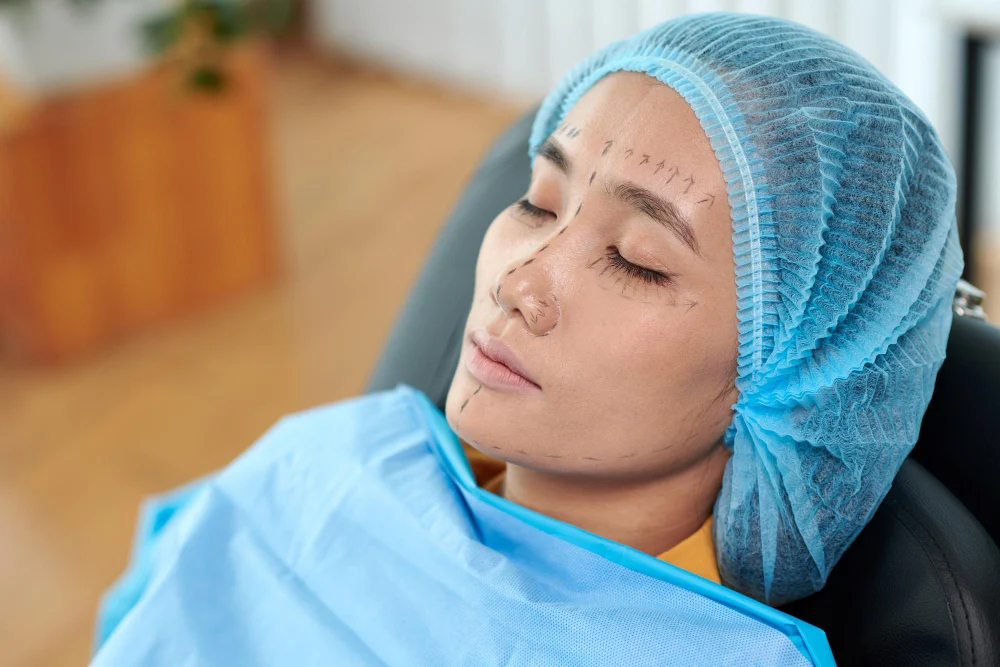
Summary:- Concerned about neck lift surgery scars? This guide explains scar placement, healing timelines, factors affecting scar visibility, and modern techniques used to keep scars discreet. Discover why most patients find their results far outweigh any concerns about scarring. One of the most common concerns patients have before undergoing neck rejuvenation surgery is not the …


Summary:– Concerned about neck lift surgery scars? This guide explains scar placement, healing timelines, factors affecting scar visibility, and modern techniques used to keep scars discreet. Discover why most patients find their results far outweigh any concerns about scarring.
One of the most common concerns patients have before undergoing neck rejuvenation surgery is not the recovery itself, but the possibility of visible neck lift surgery scars.
Many patients spend years thinking about improving their jawline, reducing neck laxity, or addressing platysmal bands, only to find themselves asking the same question during consultation:
“Will people see the scars?”
It is an understandable concern. After all, the goal of a neck lift is to create a more youthful and refreshed appearance—not to replace one aesthetic concern with another, regardless of the Best Age for a Neck Lift.
The good news is that modern neck lift surgery is specifically designed to minimise the visibility of neck lift scars. In the vast majority of patients, scars heal extremely well and become difficult to detect once fully matured.
Understanding where scars are placed, how they heal, and what influences scar quality can help patients approach surgery with realistic expectations and greater confidence, helping them choose an expert Necklift Surgeon in London for Natural, Long-Lasting Results.
Where Are Neck Lift Surgery Scars Located?
The location of neck lift surgery scars depends on the type of neck lift being performed.
In a comprehensive neck lift procedure, incisions are typically placed:
- Around the natural contours of the ear
- Within the crease in front of the earlobe
- Around and behind the earlobe
- Within the natural fold behind the ear
- Within the hair-bearing scalp behind the ear
- Occasionally beneath the chin when deeper neck structures need to be addressed
These locations are carefully chosen because they allow the surgeon to improve neck contour while keeping scars hidden within natural anatomical shadows and creases.
For most patients, the scars are not positioned in highly visible areas of the neck itself. Instead, they are concealed around the ears and hairline where they are rarely noticed by others.
Not All Neck Lift Scar Patterns Are the Same
One important point that is rarely discussed is that there is no single incision pattern used for neck lift surgery.
Most surgeons place incisions around the ear, but the way the incision is extended behind the ear can vary considerably.
Traditionally, many surgeons continue the incision behind the ear, crossing the mastoid region before extending vertically down the hairline.
While this approach can be effective surgically, it often places a portion of the scar in an area that may become visible when the hair is worn up in a ponytail, bun, or shorter hairstyle.
For some patients this may not be a concern. For others, particularly women who frequently wear their hair up, scar visibility can become an important consideration when evaluating Platysmaplasty vs Neck Lift approaches.
My own approach differs slightly.
After following the natural crease around the earlobe and behind the ear, I place the incision high within the postauricular crease behind the upper portion of the ear. The incision then extends horizontally into the occipital hair-bearing scalp before curving gently downward in an arc.
The advantage of this design is that the scar remains concealed behind the upper portion of the ear rather than extending visibly down the hairline.
When the hair is worn in a ponytail, there is typically no vertical scar visible behind the ear.
Although this technique can create a subtle alteration of the hairline, this is rarely noticeable in everyday life. Natural hairlines vary considerably from person to person, and most individuals do not have a perfectly symmetrical or fixed hairline pattern to begin with.
For this reason, many patients prefer a scar design that prioritises concealment over strict preservation of the original hairline position.
Ultimately, scar quality depends not only on how a scar heals, but also on where it is placed. A beautifully healed scar in a visible location may attract more attention than a slightly longer scar hidden within natural anatomical shadows.
Why Modern Neck Lift Scars Are Usually Difficult to See
One of the biggest misconceptions surrounding neck lift scars is that they remain highly visible long term.
In reality, scars undergo a gradual maturation process.
Initially, a scar may appear:
- Pink
- Slightly raised
- Firmer than surrounding skin
- More visible than the final result
This is entirely normal.
Over time, however, most scars continue to soften, flatten, and fade.
By twelve months after surgery, many patients struggle to find their own scars in the mirror.
When incisions are carefully planned and tension is appropriately managed, a scar after neck lift surgery is often far less noticeable than patients initially expect.
This is particularly true in patients who:
- Do not smoke
- Follow postoperative instructions carefully
- Protect scars from excessive sun exposure
- Have no history of problematic scarring
What Influences Scar Quality?
Not all neck lift surgery scars heal identically.
Several factors influence how scars mature over time.
Surgical Technique
One of the most important factors is surgical technique.
A meticulously placed incision combined with careful tissue handling can significantly improve scar quality.
Excessive tension on wound edges can increase scar visibility, which is why modern neck lift surgery focuses not only on skin management but also on deeper structural support.
Genetics
Some individuals naturally form finer scars than others.
Patients with a history of hypertrophic or raised scars should discuss this during consultation, as previous scar behaviour can provide useful information regarding healing tendencies.
Smoking
Smoking remains one of the most important negative influences on wound healing.
Nicotine reduces blood flow to healing tissues and can adversely affect scar quality.
Sun Exposure
Ultraviolet exposure during early healing can cause scars to become darker and more noticeable.
Careful sun protection is therefore highly recommended to Keep Your Neck Lift Results Looking Great for Years to Come.
Is the Scar Under the Chin Visible?
Many patients considering a neck lift London procedure are particularly concerned about the incision placed beneath the chin.
This incision is often required when performing:
- Platysmaplasty
- Deep neck lift surgery
- Submental fat removal
- Correction of platysmal bands
Fortunately, the incision is usually placed within the natural crease beneath the chin, which accommodates The Rise of “Submandibular Gland Reduction” in Neck Lift procedures seamlessly.
Because of its location, it is rarely visible during normal conversation or social interaction.
In most patients, the scar becomes extremely inconspicuous once healing is complete.
Many patients find that friends and family notice the improvement in neck contour without ever noticing the scar itself.
How a Scar After Neck Lift Surgery Changes Over Time
One of the most reassuring things patients can understand about neck lift surgery scars is that scars are dynamic. They continue to change for many months after surgery.
Immediately after surgery, incisions are usually fine lines that may appear slightly pink or red.
During the first few weeks, the scars may become more noticeable as the body enters its natural healing phase. This is completely normal and should not be interpreted as the final result.
Typically, scar maturation follows a gradual process:
First Month
During the first few weeks, scars are often:
- Pink
- Slightly raised
- Firm to touch
- More visible than they will eventually become
Mild redness is entirely expected.
Three to Six Months
During this phase, scars often begin to soften and flatten.
Redness gradually starts to fade, and the scars become less noticeable to both patients and others.
Six to Twelve Months
Most scar maturation occurs during this period.
In many patients, neck lift scars become increasingly difficult to identify, particularly around the ear where they are concealed within natural anatomical creases.
Beyond One Year
Scar improvement can continue for well over a year.
By this stage, most patients find that the improvement achieved through neck rejuvenation vastly outweighs any awareness of the scar itself.
Scar Care After Neck Lift Surgery
Good scar care plays an important role in helping neck lift surgery scars mature optimally.
Fortunately, scar management is generally straightforward.
Most patients are advised to:
- Keep incisions clean during early healing
- Follow postoperative instructions carefully
- Avoid unnecessary tension on healing tissues
- Protect scars from sun exposure
- Use scar treatments if recommended
In selected patients, silicone-based scar products may be recommended.
These can help optimise scar maturation and reduce prolonged redness.
Perhaps most importantly, patience is required.
Scar healing is a biological process that cannot be rushed. The appearance of a scar at six weeks is very different from its appearance at twelve months.
Can Neck Lift Scars Be Revised?
In most patients, neck lift scars heal extremely well and require no further treatment.
Occasionally, however, a scar may become widened, raised, hypertrophic, or more noticeable than expected. In these situations, scar revision surgery can often improve the appearance of the scar.
Revision techniques may include:
- Scar excision and re-closure
- Steroid treatment for hypertrophic scars
- Laser therapy
- Silicone-based scar management
- Other scar-improvement techniques
It is important, however, to understand the limitations of scar revision.
A scar that has healed poorly can often be improved. A scar that is wide or raised can often be revised.
A scar that has been placed in a highly visible location is a different matter.
Scar revision can improve the quality of a scar, but it cannot fundamentally relocate a scar to a different anatomical position.
For example, when an incision extends visibly across the lower area behind the ear and continues along the hairline, the resulting scar may remain visible when the hair is worn up. While the scar itself can sometimes be improved, its location cannot simply be changed.
In selected cases, hair transplantation may help camouflage portions of a visible hairline scar by placing hair follicles in front of the scar and helping to break up its outline.
For this reason, incision planning before surgery is often just as important as scar management after surgery. A well-concealed scar is generally preferable to a visible scar that later requires revision.
Why Most Patients Worry More About Scars Before Surgery Than Afterwards
One of the most interesting observations in facial rejuvenation surgery is that patients tend to focus heavily on neck lift surgery scars before surgery.
After surgery, however, the focus usually shifts elsewhere.
Patients become far more aware of:
- Their improved jawline
- Better neck definition
- A smoother neck contour
- Reduction of platysmal bands
- A more youthful appearance
The scar itself often becomes a secondary consideration.
In fact, many patients report that they spent years worrying about scars, only to realise afterwards that the scars were far less noticeable than they had imagined.
This is particularly true when incisions are carefully planned and concealed within natural anatomical boundaries.
Final Thoughts
Concerns about neck lift surgery scars are entirely understandable and form an important part of the decision-making process for many patients.
The reassuring reality is that modern neck lift surgery is designed not only to improve the neck, but also to conceal scars as effectively as possible.
The visibility of a scar after neck lift surgery depends on many factors, including surgical technique, incision placement, healing characteristics, and postoperative care.
Importantly, not all incision patterns are the same. Careful incision planning can make a significant difference to long-term scar visibility, particularly when the hair is worn up.
In the vast majority of patients, neck lift scars become far less noticeable than anticipated and are ultimately overshadowed by the improvement in jawline definition, neck contour, and overall facial rejuvenation.
For patients considering neck lift London surgery, discussing scar placement and incision design during consultation is often one of the most valuable parts of the planning process.
Frequently Asked Questions About Neck Lift Surgery Scars
Are neck lift surgery scars permanent?
Yes. Any surgical incision creates a permanent scar. However, most neck lift scars fade significantly over time and become extremely difficult to detect.
How visible are neck lift scars?
In most patients, neck lift scars are well concealed around the ears, behind the ears, and within the hair-bearing scalp. Once fully healed, they are often difficult to see.
Will I have a visible scar after neck lift surgery?
Most patients will have a scar, but the vast majority of scars become discreet and inconspicuous once mature.
Can a deep neck lift leave a scar under the chin?
Yes. A small incision beneath the chin is often used during a deep neck lift or platysmaplasty. Fortunately, this scar is usually hidden within the natural crease beneath the chin.
Do all surgeons use the same scar pattern?
No. Incision design varies considerably between surgeons. The location of the incision behind the ear can influence how visible the scar may be when the hair is worn up.
Can visible hairline scars be removed?
A visible hairline scar can sometimes be improved, but it cannot simply be relocated. In selected cases, hair transplantation may be used to camouflage a scar by placing hair follicles in front of it.
How long does it take for neck lift scars to fade?
Most scar maturation occurs during the first twelve months, although improvement may continue beyond one year.
Book a Consultation
It’s easy and free!